Be yourself; Everyone else is already taken.
— Oscar Wilde.
This is the first post on my new blog. I’m just getting this new blog going, so stay tuned for more. Subscribe below to get notified when I post new updates.
Be yourself; Everyone else is already taken.
— Oscar Wilde.
This is the first post on my new blog. I’m just getting this new blog going, so stay tuned for more. Subscribe below to get notified when I post new updates.

When we’ll have no running water, no hyperactive emergency services, no electricity… we are going to turn back to what people did 100 years ago. Here you’ll find some “little” survival tricks popular in the early 1900’s and (some of them) useful even today.
100 years ago Gallaher Ltd printed a short “How-To” series, with clever hints for emergency situations. The cards were distributed with packs of cigarettes. All the pictures bellow are part of the George Arents Collection, The New York Public Library. Please enjoy the article.
Preparedness Hacks: Once a nuke is heading your way, you might think that there isn’t much left to do, but you would be wrong!
Because we will show you America’s natural nuclear bunkers that are also EMP proof. When the sirens start wailing, all you need to do is pick the closest one to your home, where you can take cover before it hits.


Take a wide mouthed bottle and fill it with hot water nearly to the brim. Now press the affected hand or foot tightly against the mouth of the bottle.
This will then cause a suction and pull the flesh down. The suction plus the steam will help pull out the splinter.
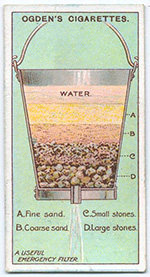
A handy and efficient water filter can be made out of an ordinary bucket.
First make a hole at the bottom of the bucket.
Instructions: “The water percolates through the layers of fine and coarse sand, and clean picked gravel and stones, with which the pail is filled, filtering through to the bottom in a clear state.”
One of the best layers you should add to this bucket is one made of charcoal.
Here are 23 survival uses for honey that you didn’t knowabout.

This method was widely used during the Middle Ages and all the engravings in swords or armors. Here are some armors engraved using this traditional way.
Instructions: “The steel to be worked upon should be covered completely with a coating of beeswax. The lettering or design to be engraved can then be drawn with the point of a clean quill pen. This lays bare the metal. A strong solution of sulphate of iron should then be repeatedly poured over the exposed surface for about ten minutes. The more prolonged the action of the sulphate the deeper will the steel be engraved.”
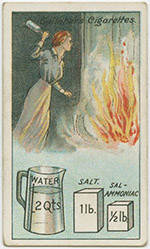
Although is good to know, probably none of us will make these old fashion extinguishers since is much easier to buy one. And because the new ones are more effective (I guess) and definitely safer.
Dissolve one pound of salt and half a pound of salt-ammoniac into two quarts of water. Then bottle the liquid in thin glass bottles holding about a quart each.
Should a fire break out, dash one or more bottles into the flames, and any serious outbreak will probably be averted.
New Survival Energy Product Makes Every Window A Powerful Solar Charger
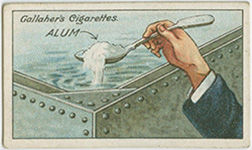
Easy! Stir in a tablespoon of powdered alum.
After 30 minutes the alum cause the particles and the bacteria to bound together and cause them to drop to the bottom leaving a clear purified water.
A tablespoon or half an ounce of alum will purify from sixteen to twenty gallons of water.
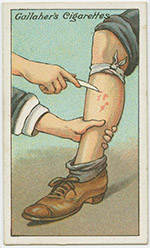
First tight a ligature round the limb above the wound. This will stop a little bit the bleeding and it will give you a better visibility to evaluate the wound.
The next advice given back then was: “Thoroughly cleanse the wound and if there is any suspicion of madness in the attacking animal the place should be well sucked and cauterized with luna caustic, or a white hot iron, after cutting away the surrounding flesh with a sharp clean knife.”
The advice was really good for that time, when there were no vaccines. And even today doctors recommend thoroughly washing the wound as soon as possible with soap and water for approximately five minutes (to reduce the number of rabies particles). Povidone iodine or alcohol is then recommended to reduce the virus further. When SHTF and we’ll no longer be able to access vaccines this is your only option available.
During a SHTF situation, pain could become an annoyance for some, but unbearable for others.
If doctors are scarce and medicine becomes even scarcer, this one little weed, found all over North America and similar to morphine, could be a saving grace.


Gas leaks can be caused by faulty appliances, or by those that have been incorrectly installed or poorly maintained.
Some of us don’t even use gas anymore (like me) or some may have gas detectors, but either way, after an earthquake, or a hurricane or a tornado there will always be gas leaks.
This 100 years old method is risk free and quite reliable.
“Paint strong soap solution on the suspected length of pipe and the gas will then cause bubbles at the escaping point, which can be dealt with at once.”

Instructions: “The familiar difficulty of lighting a match in the wind can be to a great extent overcome if thin shavings are first cut on the match towards its striking end, as shown in the picture.
On lighting the match, the curled strips catch fire at once; the flame is stronger and has a better chance.”

If a trail is lost, there isn’t much to do but to search for it.
A very good way to do that is to mark the last foot-print or sign you notice as the center of the circle and go round it at a distance of anything from 30 to 100 yards.
The trail should be discovered somewhere crossing the circular track you are following.

“A simple and homely remedy, which immediately relieves the irritation and pain caused by chilblains, is salt and fresh apple juice.
The affected parts are rubbed gently with a slice of apple dipped in common salt. A good juicy apple should be used.”
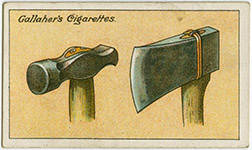
After wedging the handle of hammer as tight as possible, drill two holes at the end of wood and drive in two large screws.
An axe-head can be secured by boring a hole through the haft just bellow head and wiring through the hole and over top.
The wire should be twisted and staple driven into a hold position.
Experts predict that an EMP strike that wipes out electricity across the nation would ultimately lead to the demise of up to 90% of the population. However, this figure begs an important question: if we were able to live thousands of years without even the concept of electricity, why would we suddenly all die without it?

Take the watch of your hand. Point the hour hand at the sun and then lay a piece of wire or a blade of grass crosswise between the hour hand and the figure twelve.
The end of the wire between the twelve and the hour hand points south.

Treatment for catarrh may not be necessary because it often disappears within a few days, after your body has fought off the infection. But in some cases it doesn’t go away and it can be a health problem, especially for the underfed. In food crisis when people are poorly fed, these low-risk diseases kill more people than starvation itself.
Instructions: “Take a pinch of ordinary table salt up the nostrils, just as you would a pinch of snuff.
Then gargle the mouth and throat with warm water, being careful not to swallow it.
Do this each morning before breakfast.”
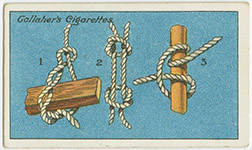
No. 1 is the Timber Hitch, which is especially useful in lifting all kinds of heavy work, such as huge beams.
No. 2, the Fisherman’s Knot, shows a good method of joining two ropes tightly together.
No. 3 is the famous Clove Hitch, which becomes tighter the harder it is pulled.
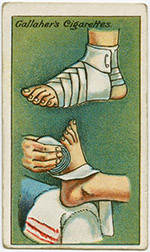
A traditional method used to make the inflammation heal faster (especially for sprain ankles) was to place a leaf of cabbage between the bandage and the ankle.
In the picture: “Rest injured foot on operator’s knee on a clear towel.
Commence bandaging in manner shown by the lower diagram, the bandage being bound over and round the back of foot in spiral fashion, and eventually fixed by means of a safety pin, just beneath ankle, as shown in upper illustration.”
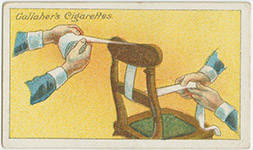
Instructions: “A roller bandage must be rolled evenly and tightly, so in the absence of a machine a chair will serve this purpose.
The picture illustrates procedure. Whilst one person carefully rolls another pulls tight opposite end of the bandage, and at the same time sees that no folds or creases are allowed to form.”
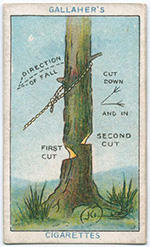
Having decided which side you wish the tree to fall, cut alternatively a downward and inward cut as you can see in the picture – in this order.
When about half through, proceed to cut the other side a few inches higher, and finally pull tree down with the help of a rope.
In a survival situation (and not only) you can use trees for their nutritious sap.
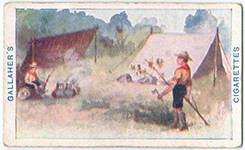
Instructions: “A simple shelter can be made by driving two forked sticks into the ground and connecting these by a pole resting on them.
Branches are then laid resting on the pole. The right angle should be around 45 degrees, and the screen fitted up with smaller branches, ferns, etc.”
(Here are 23 survival uses for honey that you didn’t know about.)
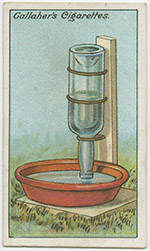
Instructions: “A simple water fountain, ensuring a supply of fresh water for the chickens, can be made from a pint wine bottle, supported by wire loops to a wooden upright as shown.
The bottle is inverted over an earthenware pan, with the mouth of the bottle about half an inch above the bottom of pan.”
I see that now there are even some “rodent resistant chicken feeders” which can be used together with the water fountain if you leave for 2-3 days.

Few things are more irritating than having something in the eye.
“Drop sweet or castor oil into the corner of the eye. Picture shows a ready method of allowing drop of oil to fall into eye from the poim of a paint brush.”
If the particle is of mortar or lime, bathe eye with weak vinegar and water.
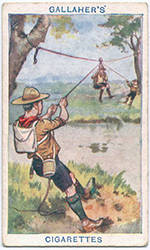
If your group has one or more people who cannot (maybe there are wounded) or don’t know how to swim, you might want to find a simple solution to help him cross a river. If there are nearby trees – and usually near rivers there are – all you need is a rope.
Fasten a strong rope to a tree and let somebody (who can swim) go across the stream and fasten the other end to a tree on an opposite bank.
Use another rope to improvise a chair fastening it into a running loop. “By means of a light rope fastened to the middle of (the) chair and held by someone at each end, those unable to swim are safely passed over.”

There are many simple and cheap DIY tricks to keep your green friends properly hydrated so that you don’t return home to a house full of wilting and yellowing plants.
A traditional method is to fill a large bucket with water, and place it a little above the level of the plants.
You can group round or near as many plants as you want. Place one end of a strand of wool in the bucket and the other one to the plant.
You can place as many yarns as you want.
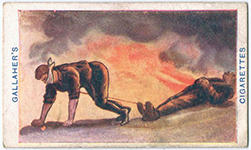
If it is necessary to enter a burning house in a search of unconscious persons, or to save a family member, first place a wet bandage over your nose and mouth and crawl in on all fours. You do this because the only Oxigen you may find is on close to the floor. (and the visibility is better)
Place a rope around his ankles. The other end of the rope around your chest or shoulders.
Then turn your back on him and drag him out. (you’re going on all fours with rope underneath)

Preserve only eggs that are newly laid. Bury them in a box of salt.
This traditional way of keeping eggs has been almost forgotten. The eggs last about an year when they are totally buried in the salt. No air whatever must be allowed to get at the shells.
This way you’ll have eggs and salt for survival.

Elevate the injured joint and wrap in cloths wrung out in cold water. The picture shows how to keep the cloths constantly wet without having to change them.
Place a jug of water higher than the injured limb and a strip of linen with one end in the jug and the other end resting upon the wrapping of sprained joint.
The water will pass from the jug to compress keeping it constantly wet and cold.
The SHTF we all prep for is what folks 150 years ago called daily life. A hundred years ago people knew how to do a lot of things – that we now take for granted. Learning how to do stuff on your own is one of the most important things that one can do to prepare… And in time of crisis you need to be able to support and sustain your family without much outside aid.
In this video, i will unearth a long-forgotten secret that helped our ancestors survive famines, wars, economic crisis, diseases, droughts and anything else life trew at them.
So pay chose attention because this video will change your life forever for the good!


Relief should look beyond the immediate medical emergency and toward new policy that would spark manufacturing, here.
Just as it was not an accident that the U.S. was unprepared for a global pandemic, it is not an accident that America is overly vulnerable to global supply chain disruption. The two phenomena are related: Four decades of purposeful neglect was engendered by an economics priesthood which any kind of national industrial strategy taboo.
The conventional economic wisdom was that it doesn’t matter what a nation produces (“Potato chips, computer chips, what’s the difference?”); that only companies, not nations, compete; that maximizing global, not national, economic welfare, matters most; that America should focus on its comparative advantage as revealed by the market; that market forces are adequate to ensure U.S. economic leadership; and that any attempts at prioritizing sectors would result in protectionism, having the government “pick winners and losers,” or some other variant of what they called crony capitalism. These positions were nonsensical before the onset of COVID-19. Today, they make even less sense.
As policy makers consider how to reduce U.S. supply chain vulnerabilities, it is important to distinguish between two kinds of sectors and products. Some globally traded sectors are not all that technologically sophisticated. If the United States lost all capacity in such sectors, and for some reason later needed to ramp up production, it easily could do so because the production “recipe” and skills for making them are not all that advanced. There is currently a shortage of medical masks for healthcare workers, but it is being solved by quickly ramping up production domestically, and going forward it could be addressed by increasing the Department of Health and Human Services’ Strategic National Stockpile.
But other sectors and products are more complicated and harder to simply order to ramp-up. America likely can ramp up ventilator production, in part because there are companies in the U.S. that can make them but also because sophisticated producers, like Ford and GM, have the technical capabilities to shift production from cars to ventilators. But when it comes to 5G equipment, for example, restoring production to the U.S. would be extremely difficult, not only because some of the components are not produced here but also because we lack a company with the technological capability of doing so. In other words, once capability in advanced production industries is lost, including in suppliers, skilled workers, and testing labs, getting it back is extremely difficult. These complex industries often involve a complex network that has developed over decades; what Seymour Melman used to call an “industrial ecosystem.”
When large numbers of trees are cut down, at some point if the surviving forest is too small, the whole ecosystem collapses. The ecosystem must be large enough to encompass all of the niches that make it work. The same applies in an industrial ecosystem: if the machine tool industry is allocated in one country, the textile industry in another, the steel industry in another, the manufacturing process becomes much more delicate and inefficient, depending on a greater range of variables to succeed. Crucially, the speed with which innovations can ricochet around the system decreases significantly. When Japanese auto manufacturers have access to Japanese machine tool makers, they can get at the machine tool advances way before GM and Ford, and their proximity becomes a competitive advantage.
These insights help to explain why the view that it is okay to offshore hardware while retaining software is not only fatuous but damaging to long-term economic welfare. It’s easy to steal intellectual property; not so easy to steal a manufacturing facility.
So, what does this imply for policy? For one thing, the coronavirus must not obscure the fact that the reindustrialization of America has to extend beyond addressing an immediate health emergency.
Additionally, businesses and policy makers must recognize that the issues in today’s economy extend well beyond thinking of labor as the most important cost variable.
This is liberating: it means that reindustrialization can take a multitude of forms: for example, 3D manufacturing is a universalizing process: one machine capable of producing a dizzying number of products that already compete with some products from global supply chains. A 3D-printing company called Formlabs is working to receive a Food and Drug Administration (FDA) exemption on 3D-printed swabs used in COVID-19 testing. Other companies are working on 3D-printed masks, face shields, ventilator valves and even testing booths.
Another important area is nanotechnology. The ability to engage in precision design and manufacture at a molecular scale presents humanity with a new frontier of materials and products that have capabilities beyond what we currently have. Products ranging from glass to suntan lotion are already vastly enhanced by nanotechnology production. Qualities of human-made materials such as fireproof, bulletproof, insulation, or space travel are in the midst of being revolutionized. Medicines can be deployed through nanotechnology at the molecular level, vastly improving their effectiveness.
But we can’t rely on the free market alone to regenerate our industrial base. Much as we did throughout most of our nation’s history, it is time for a sophisticated and capable national industrial strategy. That means first and foremost to stop flying blind. Today the government lacks the basic knowledge of what the U.S. can and cannot produce. To remedy this Congress should establish a unit within the National Institute of Standards and Technology (NIST) within the U.S. Department of Commerce, charged with understanding U.S. capabilities and gaps in advanced technology production sectors in the U.S.
Second, it means recognizing and welcoming the role that the state plays in helping to drive intelligent industrial policy. The state’s role must extend beyond passively protecting property rights and establishing a framework for the operation of efficient, rent-free markets. Congress needs to step up to the plate with policies and programs to incentivize companies to reshore critical industry production to the United States. For example, at one time many drug companies produced critical drugs and active pharmaceutical ingredients (APIs) in Puerto Rico because Section 936 of the tax code provided them with generous incentives to do so. But when that provision ended in 2006 not only did it devastate the Puerto Rico economy, it led to a rush of factories moving to China, many induced by generous government incentives over there.
Congress should also expand funding for the BioFabUSA center, one of 15 federally and industry funded Manufacturing USA centers which focuses on the production process for biotech drugs. Better technology for making drugs can reduce the costs of production, making it more economical to produce domestically.
Similar approaches should be adopted in other critical sectors. For example, companies that design but don’t manufacture semiconductors (fabless companies) should be able to receive a tax credit for having their chips made in the United States. Congress should also increase funding for the Semiconductor Technology Advanced Research Network (STARnet)—which is a collaboration of universities providing exploratory research on semiconductor system and design technology.
We also need to remember why companies moved production to China besides their government’s unrepentant innovation mercantilism: low wages. But the COVID-19 pandemic might induce a reconsideration of other inputs that add to costs, including the health risk to foreign chains, against investing in high-tech production closer to their markets.
We should also recognize that many companies that embraced the soft option of offshoring labor ultimately created grave production weaknesses in the U.S. economy and stifled innovation. This is because such actions created disincentives to move up the technology curve. As Melman recognized, however, more competent managers realized that higher labor costs could be offset by using and investing in more and better machinery, which in turn would lead to a virtuous cycle of production: higher profits, which can lead to higher wages, leading to better machinery and organization of work, and higher skills.
A key way to do that is to spur the development and use of advanced manufacturing technologies like robotics, “smart manufacturing systems,” and additive manufacturing. These technologies will underpin efforts not only to automate many functions but to increase production flexibility so factories can more easily switch to producing such items needed during crises as ventilators.
One thing we cannot do is return to a pre-globalized economy or retreat to a form of mindless protectionism. But we can and should not only reduce our dependence on China but build up America’s overall industrial base and capabilities. Even if we do that, we will still not be self-sufficient. Given the complexity of the existing and emerging technology system, that would be impossible even for an economy as large as that of the United States. But one hopes that collectively, America and its allies can re-establish leadership in key areas. To do so, the United States needs not just a national industrial strategy, but an allied industrial strategy to ensure, as a group, allied, democratic nations still have the ability to produce innovative products at competitive prices in a set of key areas while leaving us far more able to cope with sudden disruptions in supply so that we’re less vulnerable in the future. As Congress considers a fourth economic relief package, it should ensure that at least some components in it work to increase the resiliency of the U.S. advanced manufacturing economy.

I’m confident that most of you have plenty of food stocked away. Many of you have at least a small vegetable garden, and some of you even have livestock of some sort.
That’s great, but what happens during an extended disaster or a total collapse of society? Eventually, your freeze-dried food and canned goods will run out. You’ll have a tough time getting all the essential amino acids your body needs from plant-based protein sources alone. It’s not impossible, but the volume of plant-based protein you’ll need to consume will quickly whittle away your food supply.)
Fortunately, a little knowledge goes a long way because there are plenty of places to find food—especially protein, during a collapse of society. Here are nine places most people wouldn’t even think to look:

We may view dogs and cats as our cuddly little pals here in America, but they are a food source throughout the world. If society collapses and your survival is on the line, you better be ready to get over your emotions and make a meal of Fido. Since most people would be busy fighting over the last pack of Oreos at Walmart, kennels would become a great place to find plenty of fresh meat with little or no competition. The dogs and cats are even tucked into convenient cages, making you job of harvesting them simple.

The same principles apply here, but with a larger selection of choices. (Dogs, cats, birds, rabbits, fish, reptiles, etc.) You’ll find the added benefit of a stockpile of food for the animals and antibiotics used in aquariums and ponds.
I would also recommend taking a few pairs of animals you can breed for a sustainable food source. Rabbits are an ideal choice.

I appreciate the beauty of the animals you find at a zoo as much as anyone, but I will happily slaughter a giraffe to feed my family. There are a couple of things to consider here:
Based on those facts, it’s important that you have a plan, support, and weapons. A semiautomatic rifle capable of efficiently killing the target is essential, along with enough people to quickly butcher that animal. (I recommend nothing smaller than a 5.56, but preferably .308 or larger.)
In the case of predatory animals like lions or tigers, it would be wise to drag it from the cage or pen before butchering so his buddies don’t attack you during the process. Sure, you could shoot them too, but a pride of dead lions would spoil before you could eat the meat, and during a collapse you don’t want to waste anything.
Also be sure to enter with caution and stay alert at all times because you don’t know if any animals have escaped their enclosures.

You’ll probably have to harvest food from aquariums relatively quickly due to potential water contamination. They usually have robust backup generators to keep their filters running, but that is designed for natural disasters like hurricanes that may only last for several days. Once you start stretching into weeks or months, algae, bacteria, and other pathogens can quickly overtake even the largest aquariums, killing of the marine life.
You may be able to harvest some marine life relatively easily, but the larger tanks, like the one we have here at the Tampa Aquarium will require fishing gear—in some cases, heavy-duty fishing gear, to pull the fish out.

Speaking of restaurants, there are dozens of them scattered throughout most amusement parks, making them a plentiful and reliable source of food that never crosses most people’s minds.

You can find a lot of food in school cafeterias and since most of it will be either canned or dehydrated, or frozen in walk-in freezers powered by backup generators, it should be fresh for a long time to come. Keep in mind that this will only be accessible during a total collapse of society. Schools are often used to temporarily house and feed people during short-term disasters.

You’ll have to hit your local Publix pretty damn early if you hope to find anything, but even then your chances are pretty slim. People will usually mob the store leading up to the event, whether it’s a hurricane, financial collapse, or something else, and following the event, it’s one of the first targets for the unprepared. So don’t get your hopes up. It’s probably best to avoid this entirely due to the risk of violent encounters.

Like grocery stores, expect restaurants to be picked over pretty quickly, but you might find something.

Most people don’t give any thought to how the food gets to their grocery store so they aren’t even aware this exists, making it a step up from your local grocery store. When you take into account the fact that distribution centers are usually located outside of heavily populated areas, they become even more appealing during a collapse.

Now is the time to offer sanctions relief to safeguard against instability, and perhaps make an opening for peace.
North Korea doesn’t get a lot of press these days. Yet as with all pandemics, our current coronavirus crisis will end, and Washington and its allies will once again be forced to consider policy options when it comes to the hermit kingdom and its growing nuclear weapons program.
And while a return to the 2017 days of fire and fury always seem like a worst case scenario, a much darker future is possible—especially if the coronavirus creates a situation where the Kim regime were to become unstable. As of Thursday, the government there was insisting it was coronavirus free, the result of a strict tightening of its borders with China and South Korea. The rest of the world looks on skeptically, however, as global infections rise to nearly one million.
In fact, the coronavirus presents a golden opportunity for both Washington and Seoul to try a radically different approach when it comes to North Korea: the full lifting of all economic sanctions on Pyongyang until the World Health Organization deems the pandemic over.
Now, there will be many who will say this is an absolutely crazy idea, allowing Pyongyang to regain some of the economic strength it had before maximum pressure-style sanctions were put into place back in 2017. However, we should stop and consider for a moment what would happen if the North Korean regime were to become destabilized even partially. This would create an even worse coronavirus nightmare: a loss of control of the country’s vast quantities of weapons of mass destruction and the materials that make them deadly.
Consider the following scenario. What if, thanks to a poorly supplied health care system, there were tens of thousands if not hundreds of thousands of North Korean deaths thanks to the coronavirus? With millions more infected and unable to work, would Pyongyang’s normal safeguards for securing its nuclear, chemical, and biological weapons start to become lax or even nonexistent? And even if proper security measures were taken to secure weaponized systems, what if lower-priority facilities—think of labs that might have spores of anthrax or production facilities for chemical weapons such as VX—were to suddenly go unmanned? While we fear North Korea’s weapons of mass destruction being used in a deliberate fashion, the theft or sale of such weapons out of desperation seems like an even more likely threat these days.
The good news is that the Trump and Moon administrations can act now and ensure that none of that happens. As a first step, both should approach the UN Security Council and ask for a waiver on all UNSC sanctions passed from 2016 that pertain to North Korea until the WHO proclaims the current pandemic passed. Both administrations could then reach out to the Kim regime with concrete offers of food aid led by NGOs, as well as medical aid, teams of first responders and respirators. All of this would ensure that the North Korean people—through no fault of their own—do not die en masse and do not create such a strain on the North Korean health care system that it results in societal and governmental breakdown.
Once the immediate dangers of the crisis are over and coronavirus case increases are slowed, Washington and Seoul should seek to restart negotiations with North Korea. But our joint goals must be recalibrated to something approaching realistic. We should first try to lay the foundation of success by coming to agreement on things that all sides can easily agree to: a simple declaration and ceremony declaring the Korean War over would be the easiest start point. That would create the goodwill and momentum needed to begin to tackle the harder issues that are to come. It would give Donald Trump the ability to claim a major foreign policy victory during this year’s presidential campaign. It would also give Kim Jong-un a key victory as well, ceding him the political capital to make future concessions.
But then harder choices would need to be made. What to tackle first won’t be an easy decision. Starting with nuclear weapons and missiles would scuttle any talks almost immediately, so why not start with more low hanging fruit? For example, why not begin arms control talks with a focus on pulling back all soldiers and military equipment from the Demilitarized Zone by five miles? Both sides would get a chance to catalogue, inspect, and watch all equipment leave a defined space that is clearly the world’s most dangerous. This would build trust between all sides and allow tougher negotiations to build to an endpoint where nuclear weapons could be discussed but in a way that could leverage the relationships and trust already built up.
Of course, history tells us none of this will be easy. Crafting a new relationship with North Korea will take years—if not longer. However, we must ensure that the coronavirus is not the spark for a weapons of mass destruction crisis that would only make matters worse for the entire world. By lifting sanctions in the short term and trying to offer North Korea a practical path towards becoming something close to a normal nation, we can finally answer the age old question of whether Pyongyang is serious about shedding its rogue regime image. I think these small concessions are certainly worth a try.


During our boiling, broiling, blistering summer of 2012 here in the Missouri Ozarks, water was a topic of conversation wherever we went. Creeks and ponds dried up (some never recovered) and the water table dropped, forcing a few neighbors to have their well pumps lowered or to even have deeper wells drilled.
Many folks shared memories of rain barrels, cisterns, hand pumps and drawing water with a well bucket as a child, usually on grandpa and grandma’s farm. Some said they’d never want to rely again on those old-time methods of getting water. But, at least they knew how it was done.
It seems we have lost much practical knowledge in the last 50 or so years because we thought we’d never need it again. Now we are scrambling to relearn those simple know-hows.
A tattered, 4-inch thick, 1909 book I happily secured for $8 in a thrift store reveals, among umpteen-thousand other every-day skills, how to make homemade water filters. The instructions in “Household Discoveries and Mrs. Curtis’s Cookbook” are quite basic as everyone had a rain barrel back then and presumably knew how to filter rainwater. Now, 104 years later, I am thankful the authors had the foresight to preserve their knowledge for us, and pointed out that rainwater collected in barrels from a roof is a necessity in some locations, but also is best for laundry and “often more wholesome for drinking purposes than hard water.”
The “wholesome” observation applies to plants, too. I noticed during our 6-week dry spell (not a drop of rain) that I was only able to keep my vegetables alive with the garden hose – until our well, too, began sucking air. The pitiful potato, tomato and bean plants actually seemed petrified, like faded plastic decorations. Then, after a 2-hour rain shower, the plants miraculously leapt to life – vibrant, green and THRIVING. I did, too.
In early June last year, my husband surprised me with a 425-gallon water tank so I could water with nutritious rainwater, although it was August before any measure of water was in the tank. When the elusive rains finally paused briefly overhead, I was out in it with my 2-gallon watering can, running and sloshing the water like a crazy woman onto our neglected trees far up the hill.
For gardening, rainwater is, naturally, best unfiltered. But, for household use, the vintage book says the following instructions yield a cheap and easy way to make a filter just as good as a patent filter costing 10 times as much:
“Take a new vinegar barrel or an oak tub that has never been used, either a full cask or half size. Stand it on end raised on brick or stone from the ground. Insert a faucet near the bottom. Make a tight false bottom 3 or 4 inches from the bottom of the cask. Perforate this with small gimlet holes, and cover it with a piece of clean white canvas.
“Place on this false bottom a layer of clean pebbles 3 or 4 inches in thickness; next, a layer of clean washed sand and gravel; then coarsely granulated charcoal about the size of small peas. Charcoal made from hard maple is the best.
“After putting in a half bushel or so, pound it down firmly. Then put in more until the tub is filled within 1 foot of the top. Add a 3-inch layer of pebbles; and throw over the top a piece of canvas as a strainer. This canvas strainer can be removed and washed occasionally and the cask can be dumped out, pebbles cleansed and charcoal renewed every spring and fall, or once a year may be sufficient.
“This filter may be set in the cellar and used only for drinking water. Or it may be used in time of drought for filtering stagnant water, which would otherwise be unpalatable, for the use of stock. This also makes a good cider filter for the purpose of making vinegar. The cider should first be passed through cheese cloth to remove all coarser particles.
“Or a small cheap filter may be made from a flower pot. A fine sponge may be inserted in the hole and the pot filled about as directed for the above filter. It may be placed in the top of a jar, which will receive the filtered water.”
This is an example post, originally published as part of Blogging University. Enroll in one of our ten programs, and start your blog right.
You’re going to publish a post today. Don’t worry about how your blog looks. Don’t worry if you haven’t given it a name yet, or you’re feeling overwhelmed. Just click the “New Post” button, and tell us why you’re here.
Why do this?
The post can be short or long, a personal intro to your life or a bloggy mission statement, a manifesto for the future or a simple outline of your the types of things you hope to publish.
To help you get started, here are a few questions:
You’re not locked into any of this; one of the wonderful things about blogs is how they constantly evolve as we learn, grow, and interact with one another — but it’s good to know where and why you started, and articulating your goals may just give you a few other post ideas.
Can’t think how to get started? Just write the first thing that pops into your head. Anne Lamott, author of a book on writing we love, says that you need to give yourself permission to write a “crappy first draft”. Anne makes a great point — just start writing, and worry about editing it later.
When you’re ready to publish, give your post three to five tags that describe your blog’s focus — writing, photography, fiction, parenting, food, cars, movies, sports, whatever. These tags will help others who care about your topics find you in the Reader. Make sure one of the tags is “zerotohero,” so other new bloggers can find you, too.
Have a WordPress.com account? Log in now.

